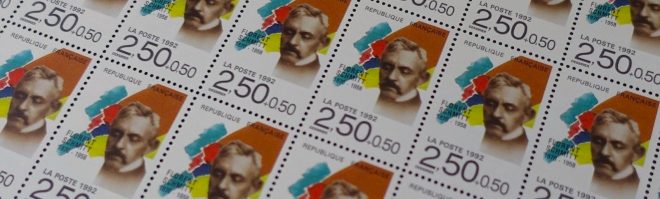
 The Dionysiaques by Florent Schmitt, composed exactly a century ago, is a blockbuster work for concert band that just gets more and more popular with each passing year.
I’ve blogged before about how this piece has become a staple of the wind band repertoire – particularly in Japan and Europe, but with more performances happening in the United States as well.
But surely the composer of a band masterpiece such as this must have written other works for wind ensemble, right?
Yes … but not extensively. It turns out that the full extent of Schmitt’s band music comprises just a half-dozen works totaling less than an hour’s worth of music between them.
And none are nearly as famous or oft-performed as Dionysiaques.
In fact, until quite recently, most of Schmitt’s other wind band compositions weren’t even available in recorded performances.
Thankfully, that’s been rectified now with the release of a recording containing all of Schmitt’s wind ensemble music on one CD. Issued on the Corelia label in 2008 — on the occasion of the 50th anniversary of Schmitt’s death — this recording features L’Orchestre d’Harmonie de la Région Centre conducted by Philippe Ferro.

Philippe Ferro
The ensemble is a group comprising amateur and semi-professional instrumentalists in addition to professional musicians. It’s a welcome addition to the Schmitt discography because it contains a good deal of repertoire that is otherwise unavailable.
The earliest of the works, Hymne funèbre, Op. 46, No. 2 for tenor solo, chorus and wind ensemble, was created in the late 1890s but didn’t receive its premiere performance until several decades later — in January 1934 — by the wind ensemble of the Garde Republicaine under the direction of Pierre Dupont, joined by a chorus of singers directed by the French composer Paul Le Flem.

The Panthéon mausoleum, built between 1758 and 1790 and located in the 5th arr. of Paris, was the site of the premiere performance of Florent Schmitt’s Hymne funèbre in 1934.
According to the Dictionnaire des oeuvres de l’art vocal, published by Bordas in 1991, Schmitt’s score was originally composed between 1897 and 1899, using a text from Alfred de Musset‘s La Coupe et les lèvres. The 1934 premiere performance occurred on the occasion of the transfer of ashes of the recently deceased former French prime minister Paul Painlevé to the Panthéon in Paris.

Jean-Joseph Émile Vuillermoz (1878-1960)
Reviewing the premiere performance in the January 5, 1934 issue of The Christian Science Monitor, music critic Émile Vuillermoz wrote:
“It is a work of great attraction written for choruses, soloists, organ and military band. Florent Schmitt excels in the use of somber colors; this Hymne enabled him to rise without effort to the most tragic eloquence.”
Considering that the Hymne‘s music predated Schmitt’s Psaume XLVII by several years, the composer’s mastery of choral writing is already clearly evident. The piece is also one of very few musical creations that ties directly to official ceremonies of the Third Republic.
Another intriguing piece is Sélamlik, Op. 48, No. 1, inspired by the Turkish ceremonial guard units assigned to the Sultan in Constantinople, and that Schmitt witnessed on parade when visiting the Ottoman Empire in the early 1900s.
Schmitt did a masterful job in capturing the guard’s combination of “pomp and savagery” in his composition, which was completed in 1904, published in 1906, and first performed in 1909 by the Garde Republicaine Band in Paris.

First recording of Florent Schmitt’s Sélamlik, issued in the late 1920s.
Unlike Dionysiaques which takes the listener through a variety of highly contrasting moods, Sélamlik conjures up an atmosphere of raucous celebration nearly continuously throughout its short duration.
You can listen to a live performance of this music on SoundCloud — a particularly winsome interpretation by Indiana University’s Jacobs School of Music Wind Ensemble conducted by Stephen Pratt. The Corelia recording of this music has also been uploaded (on YouTube).


The front cover and first page of Florent Schmitt’s score to Selamlik, edited by Felix Hauswirth. (Robert Martin Edition, Paris, 2013)
The second half of Schmitt’s Opus 48 is his March for the 163rd Infantry Regiment, which he composed in 1916. This is a longer piece of music and contains somewhat more contrasts and moods within the score.

Invencia Piano Duo (Andrey Kasparov & Oksana Lutsyshyn)
Unfortunately, only a piano reduction of the original score has survived … but that version has been recorded by the Invencia Piano Duo in Volume 3 of its complete survey of Schmitt’s music for two pianists, just released by NAXOS Grand Piano.
A live performance, also played by the Invencia Piano Duo, is available on YouTube, demonstrating how effective the music is even in the piano version.

Désiré Dondeyne (1921-2015)
At least one attempt has been made to re-orchestrate the March: Désiré Dondeyne, a composer and long-time conductor of the Parisian wind ensemble Musique des Gardiens de la Paix, completed the task, and it is this orchestration that has been recorded by Philippe Ferro and L’Orchestre d’Harmonie.
A live recording of Dondeyne leading his own band in his arrangement of the music is also available to hear, courtesy of YouTube.
According to Andrey Kasparov of the Invencia Piano Duo, the Dondeyne effort isn’t completely successful. He writes:
“There are some problems with the orchestration. For example, the middle and the bass registers are not very well supported. Schmitt himself would have never have orchestrated the work this way.
When you compare Schmitt’s orchestration of Sélamlik to Dondeyne’s of the March, the difference is evident immediately: beautifully balanced in the Sélamlik versus top-heavy in the March. Still, Dondeyne deserves credit for actually doing it.”
The Philippe Ferro recording of the Dondeyne arrangement has been uploaded to YouTube and can be heard here, as well as a different recording by the Musique Principale de l’Armée de Terre (with interesting historical images of the 163rd Regiment included in the YouTube clip), so listeners can judge for themselves about the quality of the Dondeyne arrangement.
Kasparov and others are mulling the possibility of publishing a new orchestration of the March, which would be welcome. And beyond that, we can only hope that in the upcoming years, interest in Schmitt’s music will spread beyond just Dionysiaques to encompass all of his other worthy compositions for wind ensemble.
________________________

Update (7/8/20): A televised performance of the March for the 153rd Infantry Regiment has just been uploaded to YouTube, and it features the same artists from the 2008 Corelia recording, led by music director Philippe Ferro.
The presentation was part of a 2018 concert program commemorating the 100th anniversary of the end of the First World War. You can access the video performance here.