“Florent Schmitt likes our imperfect planet; the planet reciprocates.”
— Nicolas Slonimsky, musicologist, composer and conductor

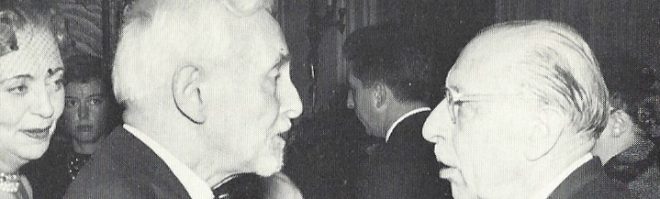
Nicolas Slonimsky (born Nikolai Leonidovich Slonimskiy, 1894-1995), was a Russian-born American musicologist, conductor, pianist and composer. This photo dates from 1933, one year after his article about Florent Schmitt was published in the Boston Evening Transcript newspaper.
In 1932, French composer Florent Schmitt made his first and only journey to the United States. The reason for the trip was to perform as soloist in the composer’s own Symphonie concertante, Op. 82 for orchestra with piano, which he had been commissioned to write for the Boston Symphony Orchestra’s 50th anniversary. Serge Koussevitzky, the BSO’s music director at the time, was both a professional and personal acquaintance of Schmitt, dating from the years following World War I when Maestro Koussevitzky had made a name for himself in Paris through his own series of concerts.

Serge Alexandrovich Koussevitzky (1874-1951)
Koussevitsky had already directed a number of Florent Schmitt’s works – among them La Tragédie de Salomé, Psaume XLVII, Rêves and Ronde burlesque – both in North America and Europe.
The Symphonie concertante would turn out to be the most challenging of them all – both from the players’ and audience’s perspectives. History has left us numerous reviews of the Boston premiere performances held in November 1932. Some critics were shocked, some were mystified and some even angry at what they heard. You can read several of the most interesting reviews in this feature article about the Symphonie concertante.

The world premiere of Florent Schmitt’s Symphonie Concertante for orchestra with piano was presented by the Boston Symphony Orchestra in November 1932. The composer was at the keyboard and Serge Koussevitzky conducted.

Florent Schmitt, photographed in about 1930. The Boston Symphony Orchestra’s commission of Florent Schmitt’s Symphonie concertante enabled the composer to travel to the United States to perform the premiere in November 1932, and subsequently to present additional concerts of his piano, vocal and chamber music with supporting musicians in major American cities including New York, Philadelphia, Detroit, Chicago, St. Louis and the West Coast. Schmitt returned to France by way of the Pacific Ocean and East Asia, including engagements en route in Honolulu and Japan. (Photo: ©Lipnizki/Roger-Viollet)
In the days leading up to Schmitt’s journey to the United States, a number of news pieces about the composer and his artistry appeared in leading American newspapers and music publications.
Notable among them, the French music journalist and author Paul Landormy was commissioned by Musical America to pen an extensive profile of Florent Schmitt that was published in the March 25, 1932 edition of the magazine under the headline “Colorful Art of Florent Schmitt Links East and West.”
Several months later, Leonard Liebling, the editor-in-chief of Musical Courier magazine, met with Florent Schmitt in Paris and shared his observations of this meeting in the July 16, 1932 issue of his publication.
But perhaps the most insightful article came from Nicolas Slonimsky, whose essay about Florent Schmitt was published in the November 26, 1932 issue of the Boston Evening Transcript newspaper at the time of the premiere of the Symphonie concertante.
The extraordinarily long-lived polymath Nicolas Slonimsky has been described variously as a conductor, pianist, composer, musicologist and lexicographer. And indeed he was all of these — and more.

Isabelle Vengerova (1877-1956) was Nicolas Slonimsky’s aunt and first piano teacher. A pupil of Theodore Leschetitzky, Mme. Vengerova taught at the Imperial Conservatory in St. Petersburg before fleeing the Russian Revolution and settling in the United States in 1923. The following year Vengerova helped found the Curtis Institute of Music in Philadelphia. She joined the Mannes College of Music in New York City in 1933, and continued to teach at both institutions until her death in 1956. Among her pupils were Samuel Barber, Lukas Foss, Leonard Bernstein, Leonard Pennario, Abbey Simon, Ruth Slenczynska and Menahem Pressler.
Born in Imperial Russia in 1894, Slonimsky studied piano in his youth with Isabelle Vengerova, a maternal aunt who would later be one of the founders of the Curtis Institute of Music in Philadelphia. In the wake of the 1917 Russian Revolution, Slonimsky’s family followed the trail of other White Russian intelligentsia by fleeing first to Constantinople and later to Paris.
It was in Paris that Slonimsky began working with Serge Koussevitzky, along with serving as a collaborating pianist with noted solo instrumentalists and vocalists. One of them – the tenor Vladimir Rosing – was appointed director of the operatic performance studio at the Eastman School of Music in Rochester, New York in 1923. Slonimsky would soon join Rosing in Rochester, continuing his composition and conducting studies with Albert Coates and Sir Eugene Goossens there.
After Koussevitzky was named music director of the Boston Symphony Orchestra, Slonimsky was invited to Boston to become Koussevitsky’s pianist and bilingual secretary. Additionally, the younger musician began teaching music theory at the Boston Conservatory while also writing music articles and reviews for the Boston Evening Transcript, the Christian Science Monitor, and other newspapers and magazines.

Charles Ives (1882-1953 was one of the composers featured by Nicolas Slonimsky in a series of concerts he presented in Europe in 1932. Florent Schmitt was present at a Paris performance and published his perceptions of the concert as follows: “In two performances at the Salle Gaveau, Mr. Nicolas Slonimsky, director of the Chamber Orchestra of Boston, gave us a sampling of current American, Cuban and Mexican musical compositions. It is difficult for me to speak in detail, after a quick and probably imperfect hearing, about eleven works of extreme complexity which, if they are not all alike, nonetheless share a family resemblance … We note — through the debauchery of polytonality and polyrhythm to which a luxuriant percussion adds sounds that are novel, bizarre and sometimes indiscreet — certain works that offer, if not an essentially original temperament, at least an authentic experience and a true understanding. Thus Three Places in New England, with a subtitle that has no false modesty: ‘Transcendental geography by a Yankee of a strange and complex genius.’ It was composed by Mr. Charles Ives, a very erudite musician who doubles as a philosopher and whom I know already for his second Pianoforte Sonata in which he celebrates, in his strong style, the writers Emerson, Hawthorne and Thoreau.”
Slonimsky’s attentions were drawn particularly to contemporary music, and he would become an ardent champion of the works of American composers such as Henry Cowell, Carl Ruggles and Charles Ives. Notably, he conducted the premiere performance of Ives’ Three Pieces in New England at Town Hall in New York City in 1931, and later presented the score in concert in Paris, Berlin and Budapest.
Slonimsky also directed the 1933 world premiere performance of Edgard Varèse’s landmark all-percussion work Ionisation.
As might be expected of someone who was so in touch with contemporary music trends of the day – not just in America but also in Europe — Slonimsky’s profile of Florent Schmitt is extraordinarily insightful. It’s chock-full of interesting and sometimes unexpected observations. Right from the outset, Slonimsky notes:
“Florent Schmitt belongs to the golden age of French music, which culminated in the first performance of Debussy’s Pelléas. It was Aldous Huxley who, in one of his ‘brief candles,’ set down this date as marking the maturity of a generation. Within a brief two years the premiere of Florent Schmitt’s Forty-Seventh Psalm took place in Paris and marked another date – the advent of studied barbarity.”
Furthermore, Slonimsky makes this trenchant claim:
“Schmitt offended the public more than Stravinsky did seven years afterward [in Le Sacre du printemps], for Stravinsky was a Russian, a Scythian, a Sarmatian — and anything could be expected of a nomad like him. But Schmitt was a Frenchman of Meurthe-et-Moselle, born during the Franco-Prussian War, native of a border state saved for France after the debacle. He was brought up in the pure Latin tradition, cultivating grace and measure, not vehemence and abandon. Upon examination of the score of the Psalm, one must admit, even in 1932, that the objectors had sufficient cause … “
In characterizing Schmitt’s style of writing, Slonimsky observes:
“He has a keen sentiment for modality and, in studying his writing, one cannot get away from the thought that he thinks in hexachords rather than in full-octave scales. He seems to abhor the inexorable landings at standardized tonics, preferring to build in free alternations of tones and semitones akin to Greek and Ecclesiastical modes.”

The best of Nicolas Slonimsky: Writings on Music, collected and published in 2003. A second volume followed a year later.
In his profile article, Slonimsky touches on other, broader aspects of Schmitt’s musical ethos as well, noting that “Schmitt seems to be the master of the entire gamut of human musical emotions – from barbarity to austerity.”
Fortunately, Nicolas Slonimsky’s daughter, Electra Slonimsky Yourke, elected to include the full essay on Florent Schmitt in a curated anthology of articles penned by her father over the course of multiple decades as a writer on music.
The essay about Florent Schmitt, which appears in the 2003 book Writings on Music (Vol. 1), is presented below in its entirety:


The fifth edition of Baker’s Biographical Dictionary of Musicians, released in 1958, was edited by Nicolas Slonimsky; he would continue to serve as editor of the publication for the next three decades.
It’s interesting to note that when he penned his essay about Florent Schmitt in 1932, Nicolas Slonimsky was already a well-known music professional of nearly 40 years of age. He would go on to flourish for another six decades – living a life full of music and its intersection with the broader culture. Among Slonimsky’s myriad professional activities, in 1958 he became editor of Baker’s Biographical Dictionary of Musicians – a position he held until 1992.

Frank Vincent Zappa (standing), pictured with Nicolas Slonimsky at a 1981 concert in Santa Monica, California at which Slonimsky performed several of his own compositions.
After the death of his wife in 1964, Slonimsky relocated to the more hospitable climate of Southern California, where he lectured on music topics at the University of California-Los Angeles.

Originally released in 1947, Nicolas Slonimsky’s Thesaurus of Scales and Melodic Patterns has remained in print ever since.
He had already become famous in the world of jazz through the publication of his Thesaurus of Scales and Melodic Patterns in 1947. The handbook would become something of a bible for a host of noted jazz composers and musicians, and remained in print for nearly 80 years.
Furthermore, it was through this connection that Slonimsky became personally acquainted with Frank Zappa, who credited the older musician as a major influence in his creative development. You can hear Slonimsky describing his musical friendship with Zappa in this audio interview remarks given to the electronic music composer Charles Amirkhanian in 1983:

“Notable and quotable”: Musical invective, curated by Nicolas Slonimsky, first published in 1953 and reprinted most recently in 2000.
Topping things off, Slonimsky’s well-known sense of humor was never on display more than in his 1953 Lexicon of Musical Invective – Critical Assaults on Composers since Beethoven’s Time – a book that would set tongues wagging for decades to come.
By the time he made a return visit to Saint Petersburg in 1992 at the age of 98 – nearly nine decades since he’d last set foot in that city – Nicolas Slonimsky was a living legend in music: Not only was he the bridge to a glorious past, but also very much a keen observer and participant in the contemporary scene.
In both respects, we are fortunate that his perceptive insights into Florent Schmitt’s musical artistry remain available to us today.
Nicolas Slonimsky is right about Florent Schmitt in two significant ways. Schmitt did indeed open the door to “studied barbarity” before Stravinsky did. But a second insight is more telling: “Schmitt seems to be the master of the entire gamut of human musical emotions …”
We do not turn to Stravinsky for his erotic touch, for any evocation of inner insight, for love, anxiety, yearning or humor. Stravinsky’s powerful eruptions ultimately devolve into spare neoclassic ironies. We need only listen to the slow movement of Florent Schmitt’s valedictory Second Symphony, written at age 87, to realize by way of contrast that Schmitt remained to the end a man of the musical heart.