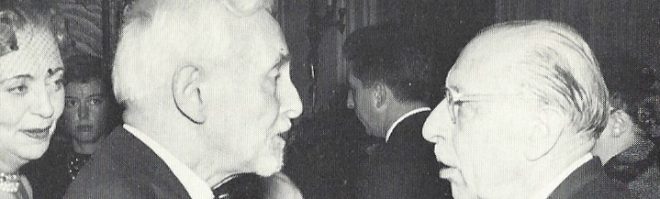

Leonard Liebling (1874-1945) was an American-born music critic, writer, pianist, librettist and sometime-composer who is best-known for being editor-in-chief of the weekly journal Musical Courier from 1911 until his death. Described as “a leading cultural figure at the time, looming large over New York City’s music scene,” he was the son of composer Max Liebling, who along with two uncles had studied with Franz Liszt. His sister, Estelle Liebling, was a Metropolitan Opera soprano and noted vocal coach. In the late 1890s Liebling studied piano with Leopold Godowsky and Theodor Kullak in Berlin, returning to the United States in 1902 when he joined the staff of the Musical Courier. In addition to his editorial duties there, Liebling was a music critic for the New York Journal-American from 1923 to 1936. He was also a librettist, responsible for penning libretti for comic operas by John Philip Sousa, Georg Jarno, Edmund Eysler and Frank Curzon. His own compositions included several works for solo piano, art songs, chamber music plus a concert overture.
In the summer of 1932, the American music critic Leonard Liebling, longtime editor-in-chief of the weekly national publication Musical Courier, sat down with Florent Schmitt in Paris, four months prior to Schmitt’s first (and only) trip to the United States, for a meet-and-greet conversation.
Mr. Liebling’s impressions of the French composer were published in the July 16, 1932 edition of his weekly column Variations – a breezy, sometimes irreverent weekly feature that could be considered an early forerunner of something akin to Norman Lebrecht’s Slippedisc.com online classical music news resource.
Several takeaways from Leonard Liebling’s meeting with Florent Schmitt are particularly insightful. The composer shared his impressions of two of his Paris Conservatoire instructors – Jules Massenet and Gabriel Fauré – and how their teaching methods differed. Schmitt also discussed his philosophy of the roles that creativity and atmospherics play in the building of music scores.

The masthead from the Musical Courier‘s July 16, 1932 issue. The weekly newspaper was established in 1880 by Marc A. Blumenberg, a former music critic at the Baltimore American and Baltimore Sun newspapers. Initially the Musical Courier covered both the artistic and trade aspects of the music industry, but in 1897 these arms were separated into two distinct publications. Leonard Liebling was the longest serving editor-in-chief of the Musical Courier (1911-45), managing a network of correspondents in Germany, France, England and Italy in addition to the United States. The penultimate owner of the publication was Lisa Roma (1892-1965), a Philadelphia-born soprano who debuted with Victor Herbert in 1920 and who went on to star on opera stages in the United States and Europe. She also toured with Maurice Ravel in the United States in 1928. In 1930 Roma was appointed chairperson of the newly established grand opera program at the University of Southern California – Los Angeles. In popular culture, she is remembered for being one of the first American recipients of a rhinoplasty operation, conducted in 1930. Roma purchased the Musical Courier in 1958 and sold it two years later to music publisher Summy-Birchard. The magazine’s final issue appeared in 1962, although Summy-Birchard (now part of Warner-Chappell) would continue to use the “Musical Courier” name on several of its annual directory publications in subsequent years.
Liebling’s full Variations column in the July 16, 1932 issue is reproduced below. While the article covers a range of musical activities happening in Europe, Liebling starts out his column with a commentary on arts critics — a commentary that has certainly lost none of its relevance in the 90+ years since it was penned:
“As a critic, I feel myself a sort of fifth wheel over here. The Musical Courier has competent critics everywhere in Europe, and it is not my mission to interfere with their estimates and budgeting. Furthermore, they would resent having any part of their work done for them.
The critics in Europe are exactly like the critics in America. They grumble at having to spend so much time listening to music, but suggest to them that perhaps they would like to delegate their job temporarily to someone else, and they bristle all over and expatiate mentally on their indispensability. Also, they shudder to think of losing their audience even for a day — and missing the personal publicity which makes breakfast so much sweeter each morning when the signed article comes to the table with the coffee and rolls. The critic is no better than the prima donna — and has relatively the same vanities and sensibilities, many of them childish and somewhat ridiculous.”
We also notice this potentially scandalous tidbit that ended up dwelling in the realm of “what might have been”:

The rumors weren’t true after all: Winifred Wagner and Adolf Hitler in Bayreuth. (Photo: ©Wolfgang Wagner/Hauptstaatsarchi)
“Rumors are flying around again insistently that Mrs. Winifred Wagner, widow of Siegfried, is to marry Adolf Hitler, German political bugaboo, very shortly. If the wedding really comes off, remember that the Musical Courier was the first paper that gave the exclusive news, over a year ago, of the rapprochement between Winifred and Adolf. Perhaps if he fails in his attempt at leadership of Germany, Hitler might become the boss of Bayreuth. That place is accustomed to dictators.”

This Leonard Liebling Variations column appeared in the July 16, 1932 edition of the Musical Courier national weekly. Liebling was editor-in-chief of the publication for more than three decades (1911-45). (Click or tap on the image for a larger view.)
But the centerpiece of Liebling’s July 16, 1932 Variations column is the accounting of his meeting with Florent Schmitt. Here is that portion of the column, output in digital form and font for easier reading:
A Meeting with Florent Schmitt
By Leonard Liebling, Musical Courier, July 16, 1932
A meeting with Florent Schmitt, distinguished French composer, held many moments of interest for me, for I always had admired the modernity and individual idiom of a creator trained in the ancient school of Lavignac, Dubois, Fauré and Massenet.

Gabriel Faure (l.) and Jules Massenet were Florent Schmitt’s composition teachers at the Paris Conservatoire. Both older composers had recognized Schmitt’s talents from the outset, and their feelings are reflected in written correspondence. Eight letters from Massenet to Schmitt survive, and they are exceptionally cordial and personal in tone.
Schmitt told me that as between Fauré and Massenet, the latter was the greater teacher, always ready with advice, correction, suggestion and even example. Fauré merely corrected and said very little. “Strangely enough,” Schmitt went on, “Fauré was the better musician of the two, much more thorough and learned. He cared nothing for teaching, however, but taught because he must. Massenet was at the Conservatoire because he loved the work, and was never happier than when surrounded by his class of admiring pupils.”

The world premiere performances of Florent Schmitt’s Symphonie concertante for Orchestra and Piano were presented by the Boston Symphony Orchestra in November 1932. The composer was at the keyboard and Serge Koussevitzky conducted. (Click or tap on the image for a larger view.)
Schmitt took the second Prix de Rome in 1897, and won the first prize in 1900. At present he is finishing the score of a new Symphonie Concertante, for piano and orchestra, and will play the solo instrument at the premiere in Boston next November, under Koussevitzky. Schmitt also has been invited to play the piano part of his Quintet in St. Louis and plans to go to Los Angeles and San Francisco, where performances of his works are in prospect. He seemed surprised that I knew some of his works other than the familiar Tragedy of Salome, and could give their opus numbers. “That is more than I can do,” he commented grimly.

Florent Schmitt, photographed in about 1930.
In appearance, with short, grizzled grey hair, keenly alert features, sharp eye, and close cropped mustache and Vandyke beard, Schmitt looks more like a banker or statesman than a musician. He was worried about a strange thing. “Tell me,” he asked anxiously, “is it true that in America people detest beards and that I shall have to shave off mine before I go there?” I reassured him, and explained that [Raoul] Pugno and Saint-Saëns, both heavily hirsute French gentlemen, had scored decided successes in America, and that General Grant, Andrew Carnegie, Jo Davidson, Charles Evans Hughes and certain other growers of beards managed to become fairly well known and respected.
Schmitt does not disparage the late modernistic experiments in music but tolerates them amiably. He holds that “atmosphere is not the sole aim of music, but only one phase of it.” In his own compositions he continues to emphasize the theory that “construction and development must be the fundamentals, with atmosphere as a suggestive and pictorial necessity.”

At the time of his death in 1945, Leonard Liebling was a resident of the Hotel Buckingham, a Beaux-Arts style building located just steps away from Carnegie Hall at 101 West 57th Street in New York City. Designed by architect Emery Roth and opened in 1929, among the hotel’s prominent guests in the arts were pianist and Polish prime minister Ignatz Jan Paderewski plus artists Marc Chagall and Georgia O’Keefe. Completely refurbished in 2013, today the building is a Hilton luxury property known as The Quin Hotel. Billed as “an artsy retreat near Central Park,” the hotel honors its storied past by offering the Quin Arts Program which features a rich variety of musical performances, art/documentary film premieres, book debuts, lectures, artist receptions and related events. (ca. 2023 photo)
It’s amusing that Schmitt, looking like a banker, feared being misperceived in Boston due to his goatee. In 1932, despite Liebling’s reassurance, Americans were, in fact, by-and-large clean shaven. While Schmitt was known for his sharp independent wit, he was socially dignified and had no desire to be seen as a counterfeit individualist of eccentric appearance. The beard remained. On that account, though, he was surely forgiven for being French!