One of the most interesting works by Florent Schmitt is his Lied et Scherzo, Op. 54, which he composed in 1910.

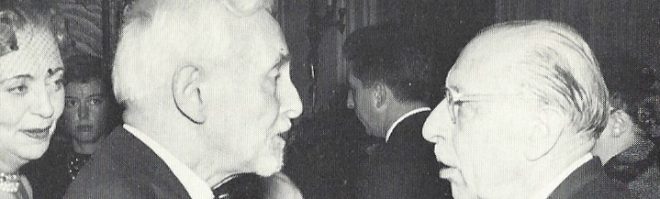
Paul Dukas (1965-1935): Florent Schmitt’s Lied et Scherzo was dedicated to his fellow French composer.
The genesis of the music was a request from Gabriel Fauré for Schmitt to write a horn competition piece for the Paris Conservatoire. The original manifestation of the Lied et scherzo was as a work for horn and piano, but Schmitt would quickly create an alternative version for double wind quintet, with one of the French horns acting as soloist throughout — and it is this latter version that has become better-known.
The work was dedicated to Schmitt’s fellow French composer Paul Dukas, who was famous for his own concertante work for French horn, the Villanelle (composed four years earlier in 1906).
In one early performance of the piece, presented as part of a concert of modern French music by Saint-Saëns, Debussy, Dukas and Gabriel Grovlez organized under the patronage of the publisher Durand, arts correspondent Frank Patterson wrote these words about the Lied et scherzo in the March 19, 1913 issue of Musical Courier:

The first performance in the United States of Florent Schmitt’s Lied et scherzo was presented by the Longy Club in Boston on January 23, 1913. It was a piece that the conservative music critic Philip Hale found difficult to appreciate, writing: “[Schmitt] is of the ultra-modern school and this Lied with Scherzo, written in 1910, proves it. The piece did not leave a definite impression. There were measures of quiet beautry, as at the close, but much of it seemed laboriously contrived and ineffectively eccentric.” The Longy Club, made up of wind players from the Boston Symphony Orchestra, was active from 1900 to 1917. Its pioneering activities are the subject of a full-length book by David Whitwell, published in 2011.
More than a decade later, when the music was heard in a concert organized by the cellist Yves Chardon at the Salle Pleyel in Paris, pianist and Musical America critic James Whitaker reported on the event in the March 31, 1928 issue of the magazine as follows:

Yves Henri Chardon (1902-2000) was a French-born cellist who played in the Boston Symphony Orchestra and later with the Minneapolis Symphony Orchestra as section principal, where he also served as assistant conductor under Dimitri Mitropoulos.
“In the course of the evening we heard the cellist drone a thoroughly inconsequential bass under the cacklings of [Jacques] Ibert’s Dixtour, sputtering mild echoes of the Viennese disturbance Schoenberg … and at the end of the evening, summoning in extremis the aid of a second-rate Yankee jazz band, Chardon presented several arrangements from his own pen of warmed-over hits — Broadway 1923.
In the center of this evening of musical madness stood, apart and sane, the short chamber opus from the pen of Florent Schmitt …
Where there is something irrational in the brilliant efforts of Darius Milhaud and something almost moronic in the indecisive wanderings of the pen of Honegger — to mention Schmitt’s chief rivals for the title of the leader of the younger musicians of Paris — there is nothing but beautifully sane and logical sequence in the writings of Schmitt, taken severally as a composer’s whole.
The Lied et scherzo … is significant, I think. Significant of the lasting, eternal superiority of form over matter. While Milhaud and Honegger in France, like Schoenberg and Stravinsky elsewhere, have been miring themselves in a vain search for new basic elements to feed into the hungry maw of their art, Schmitt has elected to concern himself directly with form. His Lied et scherzo is a deliciously lucid essay in musical adjustment. It is a telescoping of the two inner movements of the classic symphony-sonata.
If the aspect of French music of today had to be [briefly summarized], it might be said to have but two levels that are above the flood level, below which such men as Milhaud and Honegger are still awash. The one, distant and receding, is Vincent d’Indy. The other, dead ahead, is Florent Schmitt.”
Echoing Whittaker’s description of the piece, musicologist Pierre Barbier describes Lied et Scherzo as a “surprising diptych” that begins in a “dreamy, passionate” mood followed by a “fantastic, biting scherzo.”
American music critic Steven Kruger goes even further, characterizing the music as follows:

Steven Kruger
“Florent Schmitt has a remarkable ability to suggest richly implicit drama. This seemingly perky piece for ten winds begins with a slow ‘pregnant moment’ in danger of being destabilized by nervous happenings. It then brings to life a gentle French horn romance and its Petrushka-like disturbances — coincidently, Stravinsky’s ballet being composed at exactly the same time — as if painting a scene for us from the texture of daily life.
It’s such a terrific piece, you forget it was written for a small group of players.”

Frederick Fennell (1914-2004)
I’d echo Kruger’s observation: To my ears, the music sounds positively “orchestral” in its conception, notwithstanding the limited number of players. Simply put, it’s a thrilling piece of music.
Others evidently agree, including the noted American conductor Frederick Fennell who included the piece on programs of his various wind ensembles — including a December 1956 performance by the Eastman Wind Ensemble at the Eastman Theatre in Rochester plus a September 1977 performance at the Library of Congress in Washington, DC (the latter featuring the Fennell Symponic Winds with Robert Sheldon as the horn soloist).

Precision and passion: The Prague Winds’ impressive performance.
I have heard a number of recordings of Lied et Scherzo in its original all-winds form – one featuring members of the Lydian Chamber Players recorded in concert in November 1977 at the Episcopal Cathedral of St. John the Divine in New York City (released on the AmCam label) … one with the Sylvan Winds, from 1992 (on the Koch label) … another Koch label release — this one from 1994 with Janos Komives and the Serenade Orchestra … a performance featuring the Czech Nonet, recorded in 2000 and released on the Praga label … and lastly, a French recording from 2008 featuring members of L’Orchestre d’Harmonie de la Région Centre (on the Corelia label).
Of the five, my personal favorite is the Czech Nonet performance, which to my mind possesses the perfect blend of precision and ardor – not least in the challenging solo horn part.

Corbin Wagner
To experience this music in performance is a particularly special treat, because of the chance to “see” the ingenious interplay between the instruments as the musical motifs are tossed back and forth among them, particularly in the scherzo section. This recent concert performance featuring horn soloist Corbin Wagner along with members of the MSU Wind Symphony illustrates these aspects of the score beautifully.

Paul Bazelaire (1886-1958)
As with a fair number of other works by Florent Schmitt, the composer created alternate versions of this music featuring different instrumentation.
One such version features cello and piano, in which form the music was first performed in 1911 by the renowned cellist Paul Bazelaire. About that version of the piece, Schmitt biographer Yves Hucher wrote of the score’s “melodious daydreams, passionate development and fantastic rhythms,” and how the music “positively shimmers.”
[The cello version was also orchestrated by the composer, and we know that it was presented in that form by the Colonne Concerts Orchestra in 1926 — a performance described in the March 6, 1926 issue of Musical America magazine as possessing “a noble thematic outline and vigorous movement.”]

In addition to premiering the cello-and-piano version of Florent Schmitt’s Lied et scherzo, Paul Bazelaire performed the piece with its original small orchestra garb. This Colonne Concerts program from January 1926 features Bazelaire playing the music under the direction of composer-conductor Gabriel Pierné. (Vintage program courtesy of Cyril Bongers)
To my knowledge, no recorded performance exists of the cello-and-piano version of the Lied et Scherzo … but we do have a very fine performance of another alternate version of this music: the original Paris Conservatoire “competition” one featuring French horn and piano.

A personal favorite: the French horn and piano version of Lied et Scherzo with Pierre del Vescovo and Jean Hubeau.
In this case, it is a stellar realization by the impressive French horn soloist Pierre del Vescovo, joined by pianist Jean Hubeau, in an Erato recording dating from 1980.
That recording remains available today in a multi-disc set featuring five important Schmitt works for orchestra and for chamber ensemble. It has also been uploaded to YouTube on one of Philippe Louis’ fine music channels, and can be heard here.

A vintage copy of Florent Schmitt’s Lied et scherzo, in the composer’s version of the score for horn and piano.

Dennis Brain (1921-1957) (ca. 1950 photo)
Pierre del Vescovo and Corbin Wagner are just two of a number of horn players who have been attracted to the “challenging charms” of this music. The Australian-American performer Barry Tuckwell is another accomplished soloist who has played this music in recital in the United States and Canada, while the famed English horn player Dennis Brain performed the piece during his illustrious (and tragically short-lived) career.

The original LP release of the Pierre del Vescovo/Jean Hubeau recording on Erato.
The French horn/piano version happens to be my favorite of all of the permutations of this music that Schmitt created. To give you a sense of the visceral excitement that this music conveys, this live performance done by horn player Caroline Steiger and pianist Jeannette Fang is idiomatic and highly effective.
But … we mustn’t give short shrift to the composer’s fourth and final version – this one scored for piano four-hands. It had its premiere recording only in 2012 — more than a century after its creation — and was released in 2013 by NAXOS Grand Piano in a highly effective reading by the Invencia Piano Duo as part of this group’s 4-CD set of the entire catalogue of Florent Schmitt’s works for piano four-hands. A concert performance of this version by the same musicians has also been uploaded on YouTube and can be heard here.
Writing about the all-piano version of the Lied et Scherzo, the South African-British music critic Dan Morgan stated:
“Lied et Scherzo … is remarkable for its ‘solo’ passages set against discreet utterances from the ‘orchestra,’ as it were. It makes for a perky little dialogue, a strong sense of argument and counter-argument, which is always genial. It’s certainly not loquacious – that’s not Schmitt’s way – and this 11-minute tête à tête seems to pass in a flash.”
 Going further, the Invencia Piano Duo’s Andrey Kasparov has written that “the melodious Lied gradually segues into the driving and goal-oriented Scherzo, at times featuring intense polymetric layerings of contrasting materials that presage similar ideas by Ravel, Carter and others.”

The Belasco Theatre on West 44th Street in New York City. This impressive venue for the February 2, 1914 Barrère presentation of Florent Schmitt’s Lied et scherzo was built in 1907. Originally known as the Stuvysant Theatre, it was renamed for the impresario David Belasco, an early financial backer of the venture, in 1910.
As a measure of the importance of this score, the Lied et Scherzo was one of the works featured in the 1914 cross-American tour of the Barrère Ensemble of Wind Instruments, a performing group organized by the Franco-American principal flautist of the New York Philharmonic, Georges Barrère. Among the cities where the work was performed were Boston,Detroit, Cincinnati, New York City at the Belasco Theatre and also the Cooper Union — and even Charleston, West Virginia.
The New York Herald newspaper covered the Belasco Theatre concert, and in its review published on February 3, 1914 reported:
“The work that attracted the greatest interest was a Lied et scherzo of Florent Schmitt, a French composer whose music is gradually finding a place in the programs of instrumental music in this country. [It] was notable for its remarkable instrumental color. Most skillfully has Mr. Schmitt used each instrument so as to bring out the unusual effects.”

Georges Barrère (1876-1944): The French-American flautist included Florent Schmitt’s Lied et Scherzo in the repertoire of the Barrère Ensemble’s cross-American tour in 1914. Barrère would continue to be an advocate for Schmitt’s piece in the years that followed, including leading the Juilliard Wind Ensemble in presentations of the music during the years he conducted that group (1920s and ’30s).
On the other hand, as recounted in Nancy Toff’s biography Georges Barrère, Monarch of the Flute, a reviewer at another of the concerts (at the Cooper Union) wrote this of the Schmitt piece:
“Only a portion of the audience seemed to take a fancy to this latter ultra-modern music.”
One could certainly quibble about whether the music was indeed “ultra-modern” in 1914 — and it certainly doesn’t seem that way today. Either way, I find the Lied et Scherzo to be one of Schmitt’s most musically satisfying compositions, not least the incredible — and thrilling — scherzo section of the work.
I recommend that you investigate this highly interesting score. See if you don’t feel similarly.

Hans Lange (1884-1960) brought Florent Schmitt’s Lied et scherzo to Chicago audiences for the first time in 1939, as part of a concert of his eponymous chamber orchestra held at the Capital Ballroom of the Blackstone Hotel on March 27, 1939. Born in Constantinople to German parents, Lange emigrated to the United States in 1925, first serving as assistant to Arturo Toscanini at the New York Philharmonic Orchestra. Later he became associate conductor of the Chicago Symphony Orchestra, but his contract was not renewed in the wake of World War II due to his German nationality. In 1950, Lange took the helm at what would become the New Mexico Symphony Orchestra.

Lied et scherzo all over the world: This performance of Florent Schmitt’s masterpiece was presented at the Karlsruhe Institue for Technology on October 29, 2022. Also on the program were symphonies of Honegger and Schumann.