
A vintage copy of the score to Florent Schmitt’s Musiques de plein air, one of the envois submitted by the composer during his Prix de Rome period (1900-04).
As Florent Schmitt’s star has continued to rise in recent decades, one happy result has been the growing number of recordings helping to fill gaps in the composer’s discography.
The trajectory has been real: At the turn of this century, only about half of Florent Schmitt’s compositions had been commercially recorded, but that number is now reaching 75 percent or higher.
Still, there remain a number of significant works that still await their first-ever recordings. Among them are orchestral works from Schmitt’s middle period (Cançunik, Op. 79 – 1929), later career (Scènes de la vie moyenne, Op. 124 – 1950) … and one from the composer’s early efforts in preparing orchestral pieces: Musiques de plein air, Op. 44 (Music Out of Doors).
This all-but-unknown three-movement suite is one that Florent Schmitt appears to have started working on (at least in portions) before he won the Prix de Rome first prize for composition in 1900.

A photo showing the eleven candidates for the Paris Conservatoire’s Prix de Rome composition prize in 1900. Among the candidates were Jean Roger-Ducasse (far left, sitting on railing), Maurice Ravel (in the center in trench coat and bowler hat), Gabriel Dupont (standing next to Ravel on right), Florent Schmitt (reading the newspaper), and Aymé Kunc (sitting at right on the bottom steps). Florent Schmitt was judged the winner based on his secular cantata submission Sémiramis. (Photo taken at Castle Compiègne, May 1900.)

Villa Medici, Rome
It was while staying at the Villa Medici in Rome that Schmitt worked further on the composition and finally submitted it as part of his final year’s envois to the Paris Conservatoire. (It was delivered along with the orchestration of his duo-piano suite Feuillets de voyage plus the monumental choral blockbuster Psaume XLVII.)

Florent Schmitt and fellow French composer Maurice Ravel made their U.K. performing debut in 1909 on the very same program at Bechstein Hall (now Wigmore) Hall in London. Both composers performed their own piano works and accompanied vocalists. The event was organized by the Parisian impresario T. J. Guéritte, who was the dedicatee of Schmitt’s Musiques de plein air when the suite was published in 1914.
The Musiques de plein air score is marked “Rome — 1900” although the music wouldn’t be published until 1914 (by Durand). Moreover, the evidence indicates that the orchestrated piece — originally prepared in a piano version which was also published — wasn’t ready in finished form until 1903 or 1904, thereby explaining it being among the last grouping of compositions sent to Paris from Rome by Schmitt.
The composer dedicated the suite to T. J. Guéritte, an important Parisian impresario who was responsible for organizing concerts of French music in England, and who had brought Claude Debussy to London to conduct his own works. Guéritte was also the person who organized joint appearances by Ravel and Schmitt performing their own piano works at Bechstein Hall (now Wigmore Hall) in 1909, which may explain Schmitt’s dedication of gratitude.

Pierre-Octave Ferroud (1900-1936)
In his 1927 biography of Florent Schmitt, Pierre-Octave Ferroud explains that Musiques de plein air was comprised originally of four parts rather than three. One — Scintillement — was later included in Schmitt’s piano score Sept pieces, Op. 15, while another — Marche burlesque — was published in piano as well as orchestral versions as part of Feuillets de voyage, Op. 26. As these two movements were dropped, Schmitt added a different third number (Accalmie) to his suite.
Musiques de plein air is in three movements, as follows:

The Benedictine Abbey at Monte Cassino in Italy was the inspiration for the first movement of Schmitt’s Musiques en plein air. The peaceful nature of the music stands in stark contrast with the destruction of the abbey by bombing during World War II. Happily, the abbey would be rebuilt, and was reconsecrated by Pope Paul VI in 1964. (Photo: ©Koram Photography)
- La Procession dans la montagne (The Mountain Procession) — Marked Lent, the first movement portrays a solemn procession among the trees at the base of a mountain. Reportedly, the scene portrayed was inspired by a visit Florent Schmitt had made to the Benedictine Abbey at Monte Cassino in Italy during the early days of his Prix de Rome stay. As Ferroud notes, “At first the idea may seem similar to Borodin’s In the Steppes of Central Asia or even Henri Rabaud’s Procession nocturne, but it is in fact something entirely differnt. The deliberate avoidance of monotony is carefully maintained; it is neither a flock of dreams nor even a long caravan of armed Kirghiz, but rather a collected and singing throng that passes by and disappears.”
- Danse désuète (A Dance Out of Fashion) — The second movement is marked D’une allure assez paisable (“at a very easy pace”), in three-quarter time but in a minor key. Ferroud characterizes it as “a false minuet — or rather a mazurka that is excessively slowed down, and around which swirling lines of abundant polyphony unfold as if the composer wanted to call the entire orchestra to witness the comical nature of the situation he creates. Yet he is not deceived by his own creation, and when he can no longer maintain his seriousness, he abruptly concludes this playful piece with a resounding burst of laughter.”
- Accalmie (A Momentary Calm) — Marked Lent, the final movement evokes a unsettling calm just before the arrival of a storm. Ferroud writes, “Where a vague habanera rhythm floats, the theme is reduced to a simple scale … but a scale that lacks the strength even to break, and which falls back limply after vain attempts to rise beyond its third degree. In turn, the woodwinds and strings, occasionally aided by the brass, attempt to carry it further. Giving up, they fall asleep in absolute pianissimo.”

Frederick Delius (1862-1934). Florent Schmitt prepared piano/vocal transcriptions for four of Delius’ operas between 1894 and 1902.
Regarding the final movement of the suite, the British composer and author David Eccott finds similarities between it and certain stylistic trademarks of Frederick Delius, with whom Schmitt had been working in preparing piano-reduction scores of several of Delius’ operas. Eccott writes:
“In the last of the suite’s three movements … the uneasy stillness before a storm is evoked by continual reiteration of a simple five-note figure which weaves its way through ever-changing harmonies, with some Delian touches in the orchestration.”
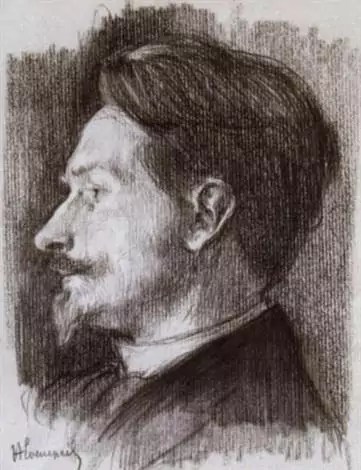
Arthur Pougin (1834-1921)
According to musicologist and author Octave Seré (Jean Poueigh), all of the chief works for orchestra sent by Florent Schmitt from Rome were performed in concerts at the Paris Conservatoire during December 1906. The December 27th Conservatoire concert that included the first two movements of Musiques de plein air also offered the premiere of Psaume XLVII. The concert was written about in the pages of Le Ménestrel magazine by music and drama critic Arthur Pougin in a piece that was more a screed than a true critique of the performances.

Désiré-Émile Inghelbrecht (1885-1965)
In addition, the first two movements of Musiques de plein air were performed the same month at the Salle Érard, with Désiré-Émile Inghelbrecht leading the Orchestre des Concerts Lamoureux.
What is intriguing about these early performances of the suite is that several orchestrated movements from other Schmitt compositions were also included under the umbrella title of Musiques de plein air — specifically, the orchestrated Scintillement movement from Sept pieces, Op. 15 as well as the orchestrated Marche burlesque movement from Book 2 of Feuillets de voyage, Op. 26. In two of the concert programs there was also a mysterious additional number titled Rapsodie sur les themes populaires berlinois that appears nowhere in Schmitt’s catalogue of works. In the end, none of those items were included in the three-movement suite that was ultimately published by Durand.
As reported in French Wikipedia, the Orchestre Lamoureux lays claim to having premiered the first complete performance of the three-movement suite in 1906 — a presentation which was likely led by its then-music director, Camille Chevillard. (It would seem that the Lamoureux’s claim of presenting the premiere performance of the complete suite is incorrect.)

The Salle Érard in Paris was the site of many premieres of works by the major French and Belgian composers of the late nineteenth and early twentieth centuries. These premieres included compositions by Caplet, Chausson, Debussy, Delage, Duparc, Franck, Hahn, Honegger, Jongen, Ravel and others, in addition to Schmitt. Small in size but boasting fine acoustics, it was a particularly appropriate venue for chamber music performances. Before construction of Maison de la Radio in 1963, the hall also served as a recording studio for French National Radio.

Composer and conductor Bernard Crocé-Spinelli (1871-1932) was a Paris Conservatoire Prix de Rome winner who served as director of the Toulouse Conservatoire from 1900 to 1913. He is best-remembered for his turn-of-the-century trombone composition Solo de concours, which remains in the repertoire today.
Instead, the first Paris performance of the entire three-movement piece was presented by Louis Hasselmans and his Association des Concerts Hasselmans, given at the Salle Gaveau in January 1909. Thereafter, the work was performed at a joint Colonne-Lamoureux Concerts presentation in December 1914.
Early performances of Musiques de plein air movements happened in the French provinces as well, including the first two of the suite led by the composer himself at a December 1907 “concerts populaires” program presented in Angers. Three years later, the second and third parts of the suite were presented in Toulouse in November 1910, led by Bernard Crocé-Spinelli, director of the Toulouse Conservatoire Orchestra.

Henri Rabaud (1873-1949)
In America, Musiques de plein air was first heard at two Boston Symphony Orchestra concerts in March 1919 under the direction of the French composer-conductor Henri Rabaud.
I have been unable to find evidence of any other performances of the work by American orchestras in the 100+ years since then — nor have I found any instances of the piece being performed anywhere else in the world in recent decades.

Florent Schmitt’s fellow French composer Henri Rabaud came to Boston to present Musiques de plein air in March 1919.

The 1919 Boston Symphony performances of Florent Schmitt’s Musiques de plein air appear to have been the only ones ever presented of this music in the United States. Writing about the performance in the March 29, 1919 issue of Musical America magazine, reviewer Charles Repper was rather lukewarm about the music’s qualities: “Although having many attractive instrumental effects and certain interesting pages, the general impression was one of vagueness, especially in the first and last movements of the suite. The dance was more definite and had [an] agreeably primitive vigor of accent.”
 What’s more, we are able to hear that ORTF broadcast performance here. (For better audio quality, the performance has also been released by Forgotten Records as part of a disk that includes other music by Florent Schmitt as well as Claude Debussy.)
When you listen to this movement, the music clearly sounds like early Schmitt — yet it also exhibits a number of the “trademarks” that would come to characterize the composer’s recognizable style — from the opening English horn solo to the chromatic orchestral writing and the passionate tutti climaxes. As the American music critic Steven Kruger has remarked:

Steven Kruger
“Early pieces reveal temperament. We don’t always associate serenity and affection with Florent Schmitt’s blockbuster reputation; yet this music is loving and mild-mannered, swirling and daring, and convincingly Teutonic by turns — all parts of the Schmitt recipe to the very end.”
Clearly, Musiques de plein air is a composition that is worthy of revival — particularly now that the score has gone into the public domain and is available for purchase or rental at a very reasonable cost.
It’s also a piece that cries out for its first commercial recording. One conductor who has expressed interest in doing so is the American music director JoAnn Falletta. In fact, this work had been selected for inclusion on Maestra Falletta’s second recording of Florent Schmitt’s works on the NAXOS label (released in 2020) — a plan that couldn’t be realized due to the timing limitations on the CD. She says of the music:

JoAnn Falletta
“Musiques de plein air is a piece that has intrigued me for a long while. I am always moved by the evocative beauty Florent Schmitt creates when inspired by nature — a strong force in his creative output — and in this work he sets three beautiful scenes inspired by his Prix de Rome period that must be heard in their orchestral garb.
Schmitt lavished his color magic, including his particular love for the English horn, on the music. The result is three gorgeous landscapes which capture that special period in his life. I continue to look for the opportunity to perform and record this unjustly neglected jewel.”
Here’s hoping that in addition to Maestra Falletta, other advocates for Florent Schmitt’s music — Leon Botstein, Lionel Bringuier, Paul Daniel, Stéphane Denève, Fabien Gabel, Sascha Goetzel, Jacques Mercier and Yan Pascal Tortelier among them — will be inspired to investigate this score and finally bring Musiques de plein air into the bright light of today.
Articles such as this add to the resources available for those who seek understanding of Florent Schmitt and his legacy. I learn from them with each appearance.
Thank you for the kind words, Mr. Cooper. It is precisely the goal of this website.
How good that a recording of this is in the works! I’ve long wondered what the Musiques sounded like.
Thank you for your comment; many others wish for a first-ever commercial recording as well.
Unfortunately, at this juncture it remains an aspiration rather than a firm plan for the recording. But JoAnn Falletta is committed to making it happen — and usually she’s successful in bringing such projects to fruition, however long it takes.
Thank you for the mention in the article. I’d completely forgotten that I’d written those words. Let’s hope that one day soon we can enjoy a modern recording of Musiques de plein air, as it’s long overdue.
Thanks for all your hard work on the Florent Schmitt Website.
David Eccott
Thank you for the kind words about the website. Its goal is to educate and inform music-lovers around the world about Florent Schmitt’s amazing artistry and his important contribution to classical music. Hopefully the site is accomplishing that mission.