In a September 2025 interview, the 96-year-old composer shares her recollections of Florent Schmitt and his distinctive personality.

Pierrette Mari (Photo: ©James Bihouise, ca. 2020)
In this year of 2025, it is difficult to imagine that there are any musicians alive who’d have had personal interactions with French composer Florent Schmitt. After all, Schmitt passed away in 1958, and nearly seven decades have elapsed since then.
Yet there are a few such people still alive who can provide that link with history. One is the composer Alain Margoni, who was encouraged in his studies by Schmitt in the 1950s. In 2016 Margoni was interviewed by his one-time student, the conductor Fabien Gabel, for an article that was published on the Florent Schmitt Website + Blog — and Margoni is still with us today.
There is another example as well: the French composer Pierrette Mari, who today remains very much active professionally at the advanced age of 96.
Born into an artistic family in Nice on August 1, 1929, Mari showed notable musical aptitude from an early age. Studies at the Nice Conservatoire between 1943 and 1946 culminated in her obtaining prizes for piano, music theory, harmony and music history, after which she matriculated to the Paris Conservatoire in the early 1950s where she studied in the classes of Noël Gallon, Tony Aubin and Olivier Messiaen and won first prizes in counterpoint and fugue. Mari’s first opus-numbered composition dates from 1953, and she has been writing music throughout the ensuing seven decades.
Mari creates music in an “agreeably modern” idiom. In a 2019 interview published in Politique Magazine, she described her musical style as follows:
“I’ve always refused to adopt a specific style; I write in a very spontaneous way. I’ve always sought to make the melody prevail over the sound. For example, I feel very close to Roussel, whom I discovered in Nice, and of course to Ravel.”
Mari’s catalogue of compositions spans a wide range of musical types, with particular emphasis on piano pieces, chamber music and orchestral works. Another area of focus is vocal/choral music, which ties in with Mari’s love of words and poetry. About her vocal creations, Mari notes:
“There is a particular way of treating a melody; you have to feel the rhythm, the cadence, the atmosphere, and it is the poem that drives the music. I have produced around forty mélodies. Puget, Valéry, Apollinaire, Lorca, Eluard, Rilke and Aragon are among the writers who have inspired me.”

A poster announcing a November 2019 concert featuring the music of Pierrette Mari and three additional French composers. A similar tribute concert is planned for December 2025 as part of the annual Albert Roussel International Music Festival.

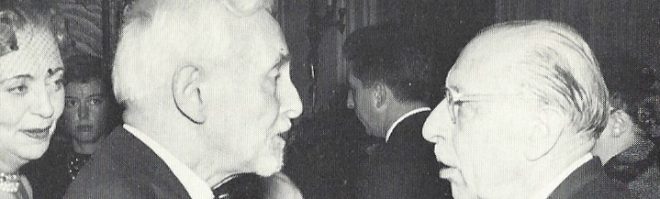
Composer Florent Schmitt with pianist Marguerite Long, photographed together at a Paris reception marking the release of the first recording of Schmitt’s Psaume XLVII in February 1953, several years before Pierrette Mari was named press attaché for the Long-Thibault Competition. (Photo courtesy of Emmanuel Jourquin-Bourgeois)
Meeting the esteemed pianist Marguerite Long in 1957 resulted in adding new dimensions to Pierrette Mari’s career in music. Long asked Mari to take up the post of press attaché for the Long-Thibault Competition, a position Mari would hold for six years.

Pierrette Mari and Olivier Messiaen, photographed in 1965 at a reception marking the release of Mari’s biography of the older composer, who had once been her teacher at the Paris Conservatoire. (Photo: Joël Brunerie)
In the late 1950s Mari also began working with Henri Dutilleux, who asked her to write analyses of his compositions. Mari would eventually become an noted musicologist, teaching at the Sorbonne while also penning the first biographies of both Messiaen (1965) and Dutilleux (1973).

Dedications penned by Henri Dutilleux (1973) and Olivier Messiaen (1965) on first-run copies of Pierrette Mari’s biographies of the two French composers.
Moreover, Mari’s musicological work pertaining to the artistry of Béla Bartók — including a biography — is notable, and over the years she has contributed writings on various classical music topics to numerous French-language periodicals.

Some key milestones in Pierrette Mari’s career in music.

Pierre Lantier (1910-1998) was a French composer who won the Prix de Rome composition competition in 1937. He is best-known for his chamber music, particularly works for saxophone and other wind instruments. Lantier was the husband of fellow-composer Paule Maurice, with whom Pierrette Mari studied privately before entering the Paris Conservatoire in the early 1950s.
As for Pierrette Mari’s interactions with Florent Schmitt, those began in 1950 when the composer Pierre Lantier brought her into the Société nationale de musique. At the time, Schmitt was still president of the organization (having been named to the position in 1937). Mari would work with the SNM for nearly two decades as its treasurer and concert organizer. In fact, the organization’s headquarters was moved to Mari’s home on Rue de Grenelle (5th arr.) where they would remain for 18 years.
Mari’s tenure at the SNM also entailed working with Schmitt’s three successors as president of the organization: Pierre Hasquenoth, Serge Nigg and Jacques Castérède.

Damien Top, photographed on tour in Melbourne, Australia (2012).
I was made aware of Pierrette Mari’s personal connection to Florent Schmitt by the French tenor, author and impresario Damien Top. In addition to his stage career, Mr. Top is the president and artistic director of the Albert Roussel International Centre (CIAR), an association established in 1992 that is dedicated to the appreciation and advancement of the artistic legacy of France’s “Golden Age” of music.
Focused on French musical culture from the late 19th century up to the present day, CIAR presents the annual Albert Roussel International Music Festival, while its multimedia collection consists of thousands of pertinent documents ranging from manuscripts, letters, autographs and photographs to books, periodicals and recordings.
Moreover, CIAR has embarked on an artistically significant and highly valuable series of recordings featuring the works of French composers – the majority of them discographic premieres. Among CIAR’s recording projects are releases devoted to such composers as Daniel Brel, René de Castéra, Claude Delvincourt, Claude Duboscq, Auguste Fauchard, Olivier Greif, Albert Markov, Paul Paray, Blanche Selva, Francis Thomé and Fernand de la Tombelle, among others …

Canadian-born pianist Jean Dubé has made his career in France. His repertoire is wide-ranging, from Bach and other baroque masters to present-day composers. His discography encompasses more than fifty recordings, including the 2024 Mari/Messiaen recording released by CIAR Classics.
… And Pierrette Mari as well. A 2024 CIAR Classics recording featuring Mari piano compositions played by Jean Dubé includes her early-career Thème et variations (1955) as well as the astonishing Escalades (Escalations), an extensive piano suite composed between 1955 and 1968. Three smaller works – including two late-career creations written in 2008 and 2014 – round out the recording, which also contains two excerpts from Catalogue d’oiseaux, composed by Mari’s teacher and mentor, Olivier Messiaen.
[Click or tap here to read an extensive review of the Mari recording, penned by music critic Jean Lacroix and published in the May 14, 2025 issue of Crescendo Magazine.]

The 2024 CIAR Classics recording of piano music by Pierrette Mari.
A new CIAR recording of Pierrette Mari’s chamber music compositions is in the planning stages, which will showcase her Wind Quintet – an early-career single-movement composition in three parts that figures prominently in Mari’s interactions with Florent Schmitt as recounted below. Appropriately, this recording will also include Florent Schmitt’s Chants alizés — a work dating from the 1950s that was likewise written for wind quintet — as well as a quintet by Yvonne Desportes, all featuring the musicians of the Aquilon Quintet.
In September 2025, Damien Top was kind enough to conduct an interview with Pierrette Mari for the Florent Schmitt Website + Blog — and her remembrances are presented below. (Note: The interview has been translated from French into English.)
DT: Please tell us a little about how Florent Schmitt was instrumental in the early acceptance and success of your Wind Quintet.

Noël Jean-Charles André Gallon (1891-1966) was a French composer, pianist and pedagogue who won the Prix de Rome first prize for composition in 1910. He joined the faculty of the Paris Conservatoire in 1920 where he served as professor of solfège and later counterpoint. The list of Gallon’s students at the Conservatoire reads like a “who’s who” of twentieth century French classical musicians.
PM: My Paris Conservatoire instructor, Noël Gallon, would offer his students the privilege of hearing their compositions (worked on in the fugue class), played not just on the piano but also by musicians completing their instrumental classes. In 1952 Gallon, who had followed my work on my Wind Quintet with great interest, decided to include the piece in a concert held at the Berlioz Hall at the Conservatoire. The fabled Berlioz Hall had been frequented by Florent Schmitt when, beginning in 1889, he attended the composition classes of Jules Massenet and Gabriel Fauré. Maurice Ravel was his fellow-student there as well.
Typically, student scores from the third year of counterpoint study were accepted [for performance]. I was barely in my second year (and had just completed my first exercises in the fugue class), so this was quite an honor.
As it turned out, my score was remarkably well-performed. At the end of the concert, I was approached by Florent Schmitt, whom I had first met two years earlier at the Société nationale de musique, which he chaired and which welcomed students from the composition classes as soon as they received their first prize at the Conservatoire. Deeply impressed to be approached the master—often feared for his harsh judgments—I certainly didn’t expect the compliments he addressed to me in front of Noël Gallon and my parents.
“What I have just heard is not a student’s work,” Schmitt declared. “It is a work of a true composer that can already be included in the nomenclature of chamber music.”
The Quintet, having received due recognition after Florent Schmitt’s stamp of approval, was included in a public concert in February 1966 in Metz. Following its warm reception there, the ORTF of Champagne-Lorraine recorded it with the same performers (musicians from the Metz Opera Orchestra and Radio-Luxembourg Orchestra) conducted by Louis de Froment. This concert was broadcast on February 14, 1966.
DT: The 1955 Prix de Rome competition is another milestone in your career as a budding composer. What can you tell us about that experience?
PM: To achieve the recognition that the Prix de Rome brings to a student who has completed the so-called “writing” classes at the Conservatoire (harmony, counterpoint, fugue), one had to be selected by the composition professors. Only a dozen slots were allowed.

The Château de Fontainebleau. Many an aspiring French composer has stood on the magnificent front steps of the palace — including Florent Schmitt, who would compete five times before winning the Prix de Rome first prize for composition in 1900.
The first test consisted of being confined to the Château de Fontainebleau, whose magnificence mitigates the draconian conditions imposed on the candidates for the one week.
Meal times were limited to one hour. There was a strict obligation not to communicate with one another—a confinement that, despite its demands, is not perceived as a chore when one considered the privilege of having been granted permission to attempt this adventure. Indeed, students set to work (ten hours per day) with enthusiasm and determination, fueled by the joy of expressing themselves.

This May 3, 1939 group photo portrays Prix de Rome “logistes” just before entering their loges at the Château de Fontainebleau to work on their compositions. Pierrette Mari’s experience would have been very similar at the 1955 competition.

The missing link? Florent Schmitt composed no operas in his musical career, but a news item in the July 12, 1919 issue of Musical America hints at a operatic project that wasn’t destined to come to fruition: “For the [Paris] Opéra, Florent Schmitt is to compose the music of a modern fairy opera entitled Blanc et noir, the text of which is now being written by Saint-Georges de Bouhélier.'” The librettist, Stéphane Georges Lapelletier de Bouhélier (1876-1947) was a poet and dramatist who penned the words to a 1902 choral work by Gustave Charpentier commemorating Victor Hugo. His adaptation of Sophocles’ Oedipus Rex, staged in Paris (1919) and London (1920) was roundly panned by critics, with New Age magazine noting that attendance was “miserably small.” This failure may have contributed to the cancellation of the Blanc et noir project.
I had won First Prize for fugue at the previous year’s competition in 1954, and on the evening of the second day (although I had always doubted the quality of my work), I was ready to tackle the second part, which was exhilarating because of the freedom one has and which one had been deprived of when writing the fugue in strict academic form.
DT: It’s my understanding that Florent Schmitt was on the jury at the ensuing performance …

Roger Boutry (1932-2019), French composer and conductor.
PM: Yes. On the grueling day of the performance before the formidable jury, I could be satisfied after hearing my work (played four-handed, with Roger Boutry, the First Prize winner in 1954).
I was informed, when the results were announced, that I had been ranked first for the fugue. The chorus reduction was well-sung. (Rereading my score a few decades later, I was gratified to note that despite some expected weaknesses for a beginner, I was pleased that the piece was neither poor nor insignificant.)
The agonizing moment of the announcement of the results compounded the state of exhaustion we had been experiencing for the past ten days. Six “logistes” were eligible for the daunting one-month lodge period, but who would they be? The names of the first, second, third, etc. (I was expecting a third or fourth place) were then announced.
Unfortunately, I obtained only seventh place and was therefore eliminated.

Florent Schmitt, photographed at his home in St-Cloud in 1953. (Photo: ©Lipnitzki/Roger-Viollet)
Then there was a great hubbub in the hall. I was standing, stunned, in front of my parents when I saw Florent Schmitt approach us. With a tone of revulsion at this verdict, he told my father how indignant he was. He added that he had followed my progress since Noël Gallon’s class, that he knew of the quality of my work, which gave hope for success in the path I was pursuing.
“She shouldn’t be discouraged! I defended her beyond what a jury member can do,” Schmitt declared. And he added vehemently, “Next year – I promise you – she will easily reach the competition’s prize list.” To which my father replied, “She will advance if her work deserves it, but this is the year you recognized that she should succeed.”
At this, we departed from this great composer who I greatly admired, and who had informed me that he was very interested in my studies after hearing my Wind Quintet.
DT: You have referenced Florent Schmitt’s activities with the Société nationale de musique. Can you tell us more about this?

The logo of the Société nationale de musique. Notice the Latin motto adopted by the organization at the time of its inception in 1871: “Ars Gallica.”
PM: The motto of the Société nationale was “Ars Gallica.” It symbolized and reinforced the need to promote French music. Florent Schmitt became its president in 1937-8. In addition to the composers and the fervent music lovers who attended these concerts, the Société nationale included students from the Conservatoire as soon as they received their first award in the composition class.
We traveled every year to the École normale de musique to attend the General Assemblies, knowing that we would experience unforgettable moments there.
From the first time I attended these sessions, in 1952, I was fascinated by the persona of Florent Schmitt, who was unlike anyone else who held a position of responsibility. The agenda was punctuated by Schmitt’s whimsical remarks. Puns would slip between the words of a serious conversation, diverting and delighting an audience always surprised by his jokes.
Before giving an overview of the program, Schmitt would very conscientiously examine the scores he had received over the previous months. His lucid judgment and sincere curiosity revealed the keen interest and generosity he showed toward young musicians.
I can say that this diminutive man, with the small beard adorning his face and an impetuous personal demeanor, simply eclipsed everyone else around him. Listening to him, no one would have attributed the eloquence of his speech to an octogenarian who, until his death in 1958, maintained the countenance of a man who was very alert and active.
At the Société nationale de musique, initially I didn’t have an official title because then-existing statutes stipulated that no woman was to manage the Society! Henri Martelli, much appreciated by Schmitt, was then Secretary-General. However, I held the position of Secretary-Treasurer of the SNM after Martelli’s death, from 1980 to 1993.
Recently, I presented Mathias Auclair, Director of the Music Department at the Bibliothèque nationale de France, two boxes containing the SNM archives and almost all of the programs spanning the years 1960 to 1993. In addition, a large black rectangular book contains the minutes of the general meetings, signed by Florent Schmitt.
DT: What are your thoughts about the musical legacy of Florent Schmitt?

The Gavoty/Daniel-Lesur book, published in 1957 based on the long-running radio program “For or Against Modern Music?” In the book, the authors write about how Florent Schmitt and his music remain young: “Eighty-seven? No, four-times-twenty years — plus a few years on top of that!”
PM: On June 26, 1954, Florent Schmitt was a guest on the program “For or Against Modern Music?” co-hosted by Bernard Gavoty and Daniel-Lesur. The format of this series of radio interviews with composers was to present a portrait of the composers along with hearing their opinions about contemporary music. To the question “Are you for or against modern music?”, the answer was widely discussed and shared with the show’s loyal and engaged audience.
In the dialogue between Florent Schmitt and his audience, he expressed himself with elegance and subtlety. No one can ever forget the mischievous tone with which he peppered his remarks. He had the audacity to oppose any sterile “innovation” of musicians who disguised their amateurism, aided by the prevailing snobbery of certain clans or cliques — and even to denounce by name the imposture of certain “trendy” composers.
Obviously, Schmitt’s work does not have the place it deserves in the musical canon. Being born five years before Maurice Ravel and eight years after Debussy represented a handicap. He was also too contemporary with Albert Roussel. Despite this, he had no trouble maintaining his independence by distancing himself from their inevitable influences, which were enthusiastically adopted by other composers who, over time, have come to be considered second-rate.
It is surprising that several serious musicologists like Adolphe Boschot and Guy Bernard, whose well-documented writings are considered authoritative, do not cite Schmitt in their writings on music of the first half of the 20th century. On the other hand, in the articles that have been written about Schmitt, his kindness of heart, his magnanimity towards young people, his skillful criticism where he showed himself to be an objective commentator and a conscientious analyst of new aesthetic trends, are attributes that are justly praised.
Furthermore, the situation has been changing for the better. Long overshadowed by the tyranny of the musical world since the 1950s, French composers of all persuasions are returning to the spotlight these days. I’m delighted — we’re once again hearing Delvincourt, Ibert, Schmitt, Daniel-Lesur and Françaix.
DT: Shifting topics, please tell us a little about your current activities as a composer.

Katia Krivokochenko
PM: This year I was invited to be composer-in-residence at the Albert Roussel International Festival, which had already programmed my music several times in the past. A tribute concert will take place in the north of France on November 30th, notably featuring the pianist Katia Krivokochenko.
I am indebted to you and the foundation for initiating and producing the CD “Escalades sur une piano,” released in 2024 and bringing together several of my piano works.

This photo was taken on August 27, 1944, the day that the French village of Le Broc, near Nice, where Pierrette Mari took refuge during World War II, was liberated by Nisei paratroopers (Hawaiian soldiers of Japanese origin). In the photo Pierre Mari is standing second from left, in between an unidentified member of the FFI (National Federation of French Forces) and Nisei paratrooper Tom Isao Oshiba. The other women in the photo were friends of Mari, and the small boy in the foreground is Pierre-Louis Gag of the prominent Gag family long active in the Nice theatre scene, including the famed Francis Gag performance venue. (Photo: Henriette Corot)
My newest project also involves you – and it relates to my ties to Hawaii. I have stayed in contact with Hawaiian soldiers who came to liberate the Nice region in 1944. Learning about this historical event, including various documents, letters and photos that I have kept from those days, inspired you to commission a new work inspired by this story.
It’s been a completely surreal moment, but at your request I have written the Dixtet with percussion that will be performed in the fall of 2026 in Honolulu as part of the prestigious Chamber Music Hawaii series, commemorating the liberation of Nice by Nisei paratroopers (Hawaiians of Japanese origin).

Tom Isao Oshiba, one of the Nisei paratroopers who liberated the village of Le Broc, near Nice, in August 1944. Pierrette Mari corresponded with Oshiba following the war, and today his descendants are involved with plans to premiere Mari’s new composition commemorating the Nisei actions in support of the liberation.
Conferences and activities initiated by Alliance française will complement this concert in Hawaii as well as one in Los Angeles. In the meantime, descendants of these Nisei soldiers have been located, and everyone is passionate about the project.
I’m also very pleased that a new CD, including my Wind Quintet along with Florent Schmitt’s Chants alizés, is in the planning stages for recording and release by CIAR Classics. Bringing these two works together on the same recording is particularly gratifying, considering how inspirational Schmitt’s words were to me back in the early 1950s when I was still a young student of composition, just starting out in my career.
________________________

The first edition of Pierrette Mari’s biography of French composer Henri Dutilleux, published in 1973. Subsequent printings of the biography were made in 1988, 1998 and 2004.
We are indebted to Pierrette Mari – and to Damien Top – for capturing these cherished memories from so many decades ago. In a time when personal connections to France’s “Golden Age” of music have sadly become all too rare, it is a privilege to be given this window into a glorious musical past.
Pierrette Mari’s account of Florent Schmitt’s helpfulness when she was a young music student revolves around his objectivity and his unbiased interest in new forms of expression, without seeming to belong to any musical camp himself. It’s a reminder that Schmitt’s approach to composition always made him hard to peg — precisely because he was never a counterfeit individualist, looking to fit into a trend.