

Villa Medici, Rome
In the century-long period from 1850 to 1950, the Prix de Rome prize for composition was probably the single most important and prestigious recognition for any French composer. And for that reason, nearly every important French composer strove to win it.

The Paris Conservatoire, pictured during Florent Schmitt’s time there as a student (Rue de Madrid entrance).
Offered to students at the Paris Conservatoire, winners of the award were rewarded with a handsome stipend, along with a multi-year stay at the Villa Medici in Rome in the company of fellow composers plus artists, sculptors and architects.
While in Rome, award recipients were free to follow their own artistic pursuits — the only requirement being to send back periodic envois to the Conservatoire, which for composers meant various works of music composed during their time in Rome.
Some composers were successful on their first or second attempt at winning the coveted prize, such as Claude Debussy in 1884. Others tried numerous times but were never successful, like Ernest Chausson and Maurice Ravel.
Like so many of his fellow composers, Florent Schmitt competed for the prize multiple times, beginning with the secular cantata Mélusine in 1896 … followed by Frédégonde in 1897 … Radegonde in 1898 … and Callirrhoé in 1899.

Two letters written by Florent Schmitt’s composition teacher, Gabriel Fauré, to the French soprano Lucienne Breval, requesting her agreement to sing Schmitt’s second Prix de Rome cantata, Frédégonde, which won the second prize for composition in the 1898 competition. It is unclear if Mlle. Bréval ever sang the role, although she did perform other works by the composer — among them the Quatre lieds (written in 1912).

A photo showing the 11 candidates for the Paris Conservatoire’s Prix de Rome composition prize in 1900. Among the candidates are Jean Roger-Ducasse (far left, on railing), Maurice Ravel (in the center in bowler hat), Gabriel Dupont (standing next to Ravel on right), Florent Schmitt (reading the newspaper), and Aymé Kunc (sitting at far right on the steps). Florent Schmitt was judged the winner based on his cantata submission Sémiramis. (Photo taken at the Palais de Compiègne, May 1900.)

This news article reports on the start of the 1900 Prix de Rome composers’ competition, wherein “these budding masters deliver all the riches of their imagination to put to music the subject of Sémiramis.” The handwritten manuscript is signed “Paul Darzac” — the nom de plume of Charles Questé, a dramatic artist and an administrator of theatrical tours in France the early 1900s.
At last, in 1900 Schmitt won the Prix de Rome first prize for composition on his fifth attempt with his secular cantata Sémiramis, Opus 14, scored for three solo voices and orchestra.

Sémiramis, the composition that won Florent Schmitt the Prix de Rome in 1900. The words for the lyric scene were created by Eugène-Félix Adenis-Columbeau (1854-1923), a playwright who was also responsible for contributing lyrics and libretti to numerous cantatas, operas and choral works created during the late 1800s and early 1900s.
The first public performance of Schmitt’s cantata happened on November 3rd in a Paris Conservatoire performance led by Paul Taffenel. A review of the premiere was published in the November 18, 1900 issue of Le Guide musical, which stated:

Claude-Paul Taffanel (1844-1908) was a noted French flautist who also directed the Paris Conservatoire Orchestra and conducted Paris Opéra productions from 1890 onwards.
“In the annual public session of the Academy of Fine Arts, the hearing of Sémiramis, a lyric scene by Adenis with music by Florent Schmitt — who won the first prize for musical composition this year — took place. We won’t surprise anyone by saying that the Institute’s room is the last place one should think of making music; the acoustic is deplorable there. The judgment that one is called upon to make on the music performed there is hence very difficult.
Nevertheless, it seemed to us that Florent Schmitt’s Sémiramis showed much promise. It was not in vain that he worked with masters such as Massenet and Fauré. The lessons of the latter especially have borne fruit. The young composer is not a backslider; his score is written with all the resources of modern harmony. There we discover exquisite delicacies and interesting research. The two main themes of Sémiramis — one of power, the other of enveloping grace, skillfully presented in the prelude — testify to the musician’s knowledge and the value of his inspiration. And what we particularly like about him, the the absence of any very marked originality, is that he has a horror of all banality …”

Unlike most Prix de Rome prizewinning cantatas, Florent Schmitt’s Sémiramis had a continuing life after its creation. One such performance was sung by Yvonne Besneux-Gautheron (1897-1989), a French soprano who presented Schmitt’s secular cantata in concert alongside Gustave Charpentier’s 1887 Prix de Rome cantata Didon. Émile-Désiré Inghelbrecht directed the Orchesre National in the February 13, 1939 concert at the Ancien Conservatoire that was also broadcast over French Radio. A subsequent performance of Sémiramis was broadcast over French Radio in the 1950s, in a performance led by Henri Tomasi (see below).
Also present at the premiere performance was Amédée Boutarel, a music critic for Le Ménestrel who wrote words of praise for the music — but less glowingly about Eugène Adenis’ libretto — in the magazine’s December 16, 1900 issue:
“Mr. Florent Schmitt seems to place movement and life before everything else in his lyric scene Sémiramis, where the music has momentum, warmth, and denotes real technical skill. Unfortunately, there is little interest in this legendary queen [because] the poem has reduced it too much.”
In later years, Schmitt would explain that his success in the 1900 competition was due to the non-musicians on the selection committee. He wrote:

Gabriel Fauré, Florent Schmitt’s teacher and mentor at the Paris Conservatoire.
“I had to compete five times for the Prix de Rome to win it once. And if in the end I was not left out in the cold, it was thanks to Gabriel Fauré, my much-lamented teacher, who managed to gather for me enough votes among the sculptors and painters to counterbalance the animosity of the musicians who, with the exception of Massenet, Reyer and Saint-Saens, turned thumbs-down on me. But I have no shame for all that … the important thing was the 30,000 gold francs.”

A photo of Parisian musicians taken in 1900, the year Florent Schmitt won the Prix de Rome first prize in composition. Schmitt is pictured in the back row (second from left). Other composers in the photo include Gabriel Dupont and Jean Roger-Ducasse (back row) and Maurice Ravel (front row, second from right). (Photo Courtesy of Philippe Raynald Simon)

This announcement of an upcoming Colonne Concerts presentation of Florent Schmitt’s Sémiramis on December 9, 1900 appeared in several issues of Le Guide musical. The premiere performance of the piece had occurred a month earlier (November 3) in a performance by Paris Conservatoire forces led by Paul Taffanel.
For Schmitt, his tenure in Rome was distinguished by the amount of time he wasn’t there — thereby turning the typical 24-month stay into a four-year travel adventure. Between 1900 and 1904, Schmitt journeyed to numerous European countries including Germany, Austria-Hungary and Scandinavia.

An early 1900s map of the lands of the Mediterranean. Florent Schmitt explored the region from end to end during his Prix de Rome period (1900 to 1904).
He also explored the Mediterranean region end-to-end, traveling to Sicily, Corsica, Spain, North Africa and the Near East. In doing so, Schmitt absorbed many different influences, which also contributed to his developing interest in orientalism.
In an article written in 1927 for the Christian Science Monitor, the French music critic Émile Vuillermoz described Florent Schmitt’s wanderlust — and the raised eyebrows it generated:

Jean-Baptiste Claude Eugène Guillaume (1822-1905) was a French sculptor who became director of the Académie de France in Rome in 1891, holding the position until 1904. Guillaume’s correspondence during his last years of directorship at the Villa Medici are peppered with references to Florent Schmitt’s transgressions, such as in 1902 when Schmitt was called to order for “completely losing sight of his obligations as a boarder” due to demand for his participation in concerts in London, Germany and various spa towns. The following year Guillaume complained of Villa Medici boarders who were taking too much at their leisure in terms of leave, “beginning with Florent Schmitt for whom we have more or less lost track.” In 1903, Schmitt’s orchestral tone poem Combat de Rakshasas “baffled the section, which recognized its great skill but could not say more” (although his “Danse désuète” from Musiques de plein air was deemed to have “originality and picturesqueness”). In 1904 Guillaume reported on Psaume XLVII and its “ultra-modern trends,” with the vocal parts “demanding almost impossible efforts.” (Photo: Eugène Pirou)
“[Schmitt’s] regulation stay at the Villa Medici in Rome was marked by many heroic-comic incidents caused by his love of travel. This undisciplined pensioner traversed Europe in every direction with a whim and obstinacy that more than once won him severe remonstrances. This vagabond tendency led him to the most unforeseen places and allowed him to form his imagination and his heart, at the same time as his talent.
Those fifty months outside France had a decisive influence on his outlook. One may consider as essential in the makeup of this exceptional person the ingredient of visual experience — of the reflection on things and costumes — to the same degree as that of musical training pure-and-simple. To develop himself, it was necessary for him to absorb what was lacking in the places immediately surrounding him.”

A letter from Florent Schmitt to Maurice Ravel, sent during his stay at the Villa Medici in Rome (1901). In it, Schmitt writes about the news of Ravel’s second prize in the Prix de Rome competition: “Many congratulations, my dear Ravel. I was very afraid for the Fauré class and for you, and must admit that I am pleasantly surprised as far as you are concerned — not that you obtained the second prize, which I am sure was well-due to you, but that the jury had the intelligence to give it to you. And it’s great for you that they judged you favorably right away; at least, they will receive you with pleasure next year and you won’t have, like me, four years of effort to erase a bad first impression … There’s no reason to back down, and you have no less of a first-prize chance than [Gabriel] Dupont and [Aymé] Kunc. Could we see your cantata if by chance you have some copies? Fauré must be delighted … Another thousand compliments my dear Ravel — and in the hope of seeing you here in the very near future, I kiss your forehead affectionately and will take a joint (you will learn the meaning of this bizarre expression later) to your final success …”

This invitation for a Prix de Rome dinner held on November 16, 1901 was drawn by Jacquot-Defrance, winner of the 1901 Prix de Rome First Prize for painting. Pictured in the illustration is Florent Schmitt (seated at lower center) along with fellow Villa Medici residents André Caplet, Charles Levadé and Edmond Malherbe. (Click or tap on the image for a larger view.)
The third year’s envoi was Le Palais hanté, and finally in the fourth year, Schmitt delivered to the Conservatoire five orchestrated movements from his piano duo set Feuillets de voyage, the Musiques de plein air, and Psaume XLVII.
By far the most substantial piece of music resulting from Schmitt’s Prix de Rome years, the stunning Psalm, scored for soprano, mixed chorus, organ and large orchestra, would take Paris by storm in its 1906 premiere performance. It was a composition that had breathless critics speaking of Florent Schmitt as “the new Berlioz.”

A sonic “experience”: The piano-reduction score to Florent Schmitt’s Psaume XLVII, composed in 1904 at the Villa Medici in Rome.
There is no question that the magnificent splendor of the Psalm has overshadowed the other envois that Schmitt sent from Rome. One of these, Le Palais hanté (The Haunted Palace), is a symphonic etude inspired by an Edgar Allan Poe story — a composition that Schmitt worked on from 1900 to 1904.
This piece is actually fairly well-known, and has received four recordings beginning in 1983 (Georges Prêtre), with the latest one recorded earlier this year (JoAnn Falletta, slated for release in November on the NAXOS label).

The score to Florent Schmitt’s Le Palais hanté, inscribed by conductor JoAnn Falletta who has made the latest commercial recording of this piece (2015).
All-but-unknown is another orchestral work, Musiques de plein air, Op. 44 (Outdoor Music). Schmitt had actually started work on this three-movement suite before he won the Prix de Rome. While at the Villa Medici, Schmitt completed the composition and submitted it as an envoi to the Conservatoire. The score is marked “Rome — 1900” although the music wouldn’t be published until 1914 (by Durand).
Schmitt dedicated the suite to T. J. Guéritte, an important Parisian impresario who was responsible for organizing concerts of French music in England, and who brought Claude Debussy to London to conduct his own works. The first performances of the various movements of the score were in 1906 and 1907 at the Paris Conservatoire and also at Salle Erard in Paris by the Lamoureux Concerts Orchestra. Thereafter the complete three-movement score was taken up by Louis Hasselmans and his Association des Concerts Hasselmans (presented at the Salle Gaveau in January 1909). In America, it was first heard at a Boston Symphony Orchestra concert in March 1919 under the direction of the French composer-conductor Henri Rabaud.
Musiques de plein air is in three movements, as follows:
- La Procession dans la montagne (The Procession in the Mountain)
- Danse désuète (Outmoded Dance)
- Accalmie (Lull)

A vintage copy of the score to Florent Schmitt’s Musiques de plein air, one of the envois submitted by the composer during his Prix de Rome period (1900-1904).

Residents of the Villa Medici — writers, painters, sculptors and composers — pose for a photograph on the last day of year in 1901. Florent Schmitt is pictured in the second row (at center, wearing the top-hat).
To my knowledge, this work has never been recorded commercially. Moreover, I have been unable to find evidence of the music being performed anywhere in the past half-century. However, we are fortunate in that the first movement of the suite — La Procession dans la montagne — was selected by Désiré-Emile Inghelbrecht as one of five of Schmitt’s compositions the conductor led at a French National Radio Orchestra concert in memory of the composer. The concert occurred on October 9, 1958, approximately two months following Schmitt’s death.

A vintage copy of the instrumental parts to the score for Florent Schmitt’s Musiques de plein air.
The broadcast tape from this concert has now been made available in its entirety for the first time in nearly 60 years. You can listen to the ORTF performance of the first movement of the suite here. (A special “thank you” to Eric Butruille, a faithful reader of the Florent Schmitt blog, for preparing the high-res audio file.)
While the music clearly sounds like early Schmitt, it exhibits many of the “trademarks” that would come to characterize the composer’s recognizable style — from the opening English horn solo to the chromatic orchestral writing and the passionate tutti climaxes. At the quiet conclusion of the movement, the mood is both mystical and magical.
 To my ears, this music makes one wish for the entire suite to be recorded. Here’s hoping that one of Florent Schmitt’s strongest advocates — Leon Botstein, Lionel Bringuier, Paul Daniel, Stéphane Denève, JoAnn Falletta, Fabien Gabel, Sascha Goetzel, Jacques Mercier, Yan Pascal Tortelier or some other conductor — will be inspired to investigate this score … and finally bring Musiques de plein air to the microphones.

The camaraderie of the musicians, artists and architects who resided at the Villa Medici was palpable, resulting in many lifelong friendships. This rare photograph from Florent Schmitt’s days at the Villa Medici shows him playing piano duets with fellow composer André Caplet (1878-1925), to Schmitt’s right. Looking on is the sculptor René Grégoire (1871-1945) and lounging upside-down on the sofa is the painter Jean-Amadée Gibert (1869-1945). Years later, Schmitt would recall his days with Caplet as follows, “Then radiant with strength and gaiety, his mind inclined to a mystification that did not yet go as far as mysticism, I hardly suspected that one day, alas, he would have to leave us so prematurely. We loved scores and tore them down like madmen, playing and replaying with four hands and at full speed the symphonies of Borodin and Glazunov, even the very serious ones of Bruckner and Mahler, the poems of [Richard] Strauss, Balakirev, Rimsky, the Nocturnes [of Debussy] — all works which at that time, apart from more lasting merits, still had [the reputation] of being somewhat despised …”
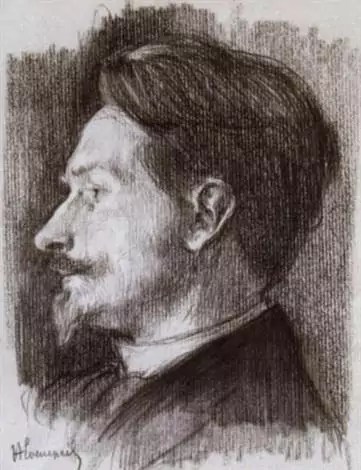
Arthur Pougin (1834-1921)
As one example of the reaction, the outcry from Arthur Pougin, a music and drama critic writing in the January 5, 1907 issue of Le Ménestrel magazine, seems almost like a cri de cœur. His “rant” is worth translating and presenting in its entirety, as it illustrates just how much resistance composers of Schmitt’s generation faced as they forged new pathways in music. Pougin wrote:
“It becomes almost frightening to see our young composers writing music such as that which M. Florent Schmitt offered us the other day at the Conservatoire, at the audition session for the Prix de Rome which was dedicated to him. We really wonder what they are thinking about and what their goal could possibly be. Do they simply intend to ‘amaze the bourgeoisie’ with procedures whose audacity seems to border on madness? Or are these aggressive and cruel procedures, in their minds, the mark of an originality that no one is yet able to appreciate or understand?

Arthur Pougin’s “tirade,” published in the January 5, 1907 issue of Le Ménestrel magazine.
Isn’t their aim more ambitious — and would they not, by chance, in hatred of the art that they cultivate though we don’t know why, have sworn to the ruin of this art by treating it in such a way that we should hate it? We don’t know what to think — and we wonder what they themselves think, if they think about anything at all.
The program included (but the public did not understand!): a symphonic study for Edgar [Allan] Poe’s The Haunted Palace; Poèmes des lacs for voice and orchestra; Musiques de plein air orchestral suite; Psaume XLVI [sic] for orchestra, organ, chorus and solo [soprano].
All this comes from the same barrel — and from a barrel which is not malvoisie wine, I can assure you. Not the shadow of an idea, not the shadow of a phrase, not the shadow of a rhythm; notes that slip into each other – ‘I go as I push you’ without knowing why — and which do not represent anything. With that, fierce modulations, a bizarre orchestra without poise and without balance, an infernal noise, cymbals (lots of cymbals!), squeaking violins, whistling flutes, bursting brass, and sopranos which also burst out … what do I know?
Hearing it, we looked at one another, anxious, dazed, wondering what it all meant and where we were going to end up. You had to see the faces of the listeners struggling with this astonishing, shattering and deafening music. Everyone seemed to be saying to their neighbor: ‘Good heavens! This is OK for one time, but they won’t do it again!’
But the fact is, this is why we have the Prix de Rome!”
___________________
 Update (11/19/19): A 1954 broadcast performance of Sémiramis, Schmitt’s prizewinning Prix de Rome cantata, has now been released by Forgotten Records. Interestingly, the musical forces are led by Henri Tomasi, who was much better-known as a composer. The sonics are quite good considering the age of the live recording.
[Archival information reveals that this wasn’t the only time that Sémiramis was performed during those times; in 1957 another live performance was broadcast over French Radio — that one conducted by Manuel Rosenthal but featuring the same vocal cast as the 1954 presentation.]
In his review of the Forgotten Records CD for Fanfare magazine, critic Steven Kruger wrote these words about Schmitt’s cantata:

Steven Kruger
“The award-winning Sémiramis, a half-hour cantata for three solo voices and orchestra … disturbed academic conventions at the time. Fascinating to the ear of history, though, is how much of Schmitt’s mature style is in evidence from the beginning. The cantata opens with a sense of chromatic menace punctuated by grim muted squawks from the brass that might as well be creepy alligator love calls. Schmitt’s tendency towards lush-but-dangerous-sounding sensuality is clearly present already — seven years before his most famous work, La Tragédie de Salomé, established his reputation as a master of sexual apocalypse. Short explosive phrases and declamations are an essential part of the mix.
Much of Sémiramis is spent emoting in time-honored French operatic fashion. (Equally given to sudden outbursts, Schmitt’s later music, culminating with the Second Symphony, is volatile in exactly the same way.) Just when one no longer expects melody, Schmitt suddenly slips in a tune worthy of Puccini …
Hindsight indicates as well that Schmitt’s fascination with strong, dangerous women as muses began early. The Assyrian queen Semiramis in legend restored the ancient city of Babylon. She also invaded Armenia when its king, Ara the Handsome, refused her amorous attentions. Semiramis was victorious, but Ara was slain in battle. As we say, dangerous!”
We are indebted to Forgotten Records for giving us the chance to hear this music until such time as a modern commercial recording can be made. The CD can be purchased on the Forgotten Records website and shipped anywhere in the world.