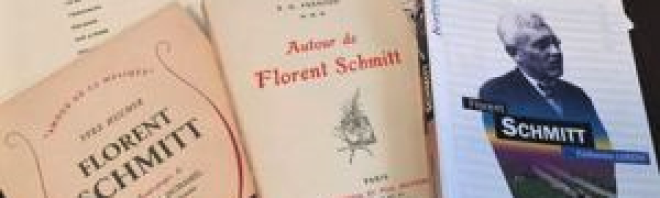
During his lengthy career, the French composer Florent Schmitt would periodically turn to the subject of children for musical inspiration – often involving pieces written for piano. In the early 1900s Schmitt composed four collections of piano duets featuring easy primo parts for young pupils. Sur cinq notes (1906); Trois pièces récréatives (1907); Huit courtes pieces […]
Tag Archives: Remus Tzincoca
During his time as a student at the Paris Conservatoire, Florent Schmitt had his share of esteemed teachers including Jules Massenet, Théodore Dubois, André Gédalge and Albert Lavignac. But Gabriel Fauré, who along with Massenet were Schmitt’s two instructors in composition, was his favorite teacher — and also arguably the most influential one. Time and again, […]
Generally speaking, music lovers who know the works of French composer Florent Schmitt are most familiar with his compositions dating from the early 1900s onward. Far less known are the numerous works the composer created in the years before the appearance of the startling and celebrated Psaume XLVII, which Schmitt composed in 1904 in Rome and which received its premiere […]
There’s no question that in the past two decades, the breadth and depth of French composer Florent Schmitt’s music that has made it to the microphones has increased dramatically. Nearly every year, we are treated to world premiere recordings of more Schmitt works. The most recent examples are the complete works for piano duo and duet as […]
We know that Florent Schmitt’s penultimate work was the Symphony No. 2, composed in 1957 and premiered in 1958 by Charles Munch and the French National Radio Orchestra a few months before the composer’s death at age 87. The question is, which composition stands as Schmitt’s first essay in the genre? Because in fact, the […]
“To appreciate this music fully, ready the hot tub, invite a few friends over, burn incense and uncork the wine you were saving for a special occasion.” — International Record Review One of the most intriguing pieces of music composed by Florent Schmitt during his “orientalist” period was the incidental music to André Gide’s new adaptation […]